
Cycle Tested Volume 2: The Evolution of Blockchain and Crypto

The Evolution of Blockchain and Crypto
An interesting topic has resurfaced in many of my recent discussions with more traditional institutional investors: the delineation between “blockchain” as a disruptive technology and “crypto” tokens as an asset. This point of discussion is both telling and indicative of the current market environment. I believe we are at a key fulcrum of institutional adoption. We are seeing positive regulatory headlines and exponential growth in the number of assets being tokenized, but we are also seeing retail capitulation, which isn’t great for token prices in a historically retail-driven market.
This dynamic presents an interesting question:
How does one differentiate between crypto and blockchain?
I actually think that we’ve seen this playbook before, though it was in the 1990s and before many crypto market participants were even born. The "internet” was both a revolutionary technology and an investable sector. It was seen as a speculative and high-risk sector; a standalone category for early adopters. There were fund managers that solely focused on internet investing, in both public and private markets, that had no real overlap with other market verticals such as consumer staples, financials, energy, or healthcare. There are many parallels between “dotcom” stocks and crypto, but also between the internet and blockchain as highly disruptive technologies. Fast forward to today, no one "invests in the internet"; it is simply the inherent plumbing of nearly every successful business on the planet. That said, between the dotcom bubble and today, there has been no shortage of massive wealth creation opportunities for these early-adopting, internet-focused investors.
From "Investable Sector" to "Global Infrastructure"
We are currently witnessing that same transition with blockchain. What was the technology solely supporting a standalone new asset class, crypto, is now evolving into the fundamental infrastructure layer for global financial services. While significant in its own right, blockchain is also expanding the definition of financial services. One of the core benefits of blockchain as a trustless peer-to-peer transfer agent is the allowance for enhanced asset productivity.
A major theme that has resurfaced over the past year is the tokenization of ‘Real World Assets’ (RWAs). This is simply taking traditional financial assets and securities and replicating them in a tokenized form. One major benefit is the potential for enhanced liquidity which comes from reducing the friction associated with traditional financial counterparties. Further, via DeFi integrations one has far more potential cost-effective options to leverage their assets as collateral to either borrow against them, or to potentially to lend out and earn additional passive yield.
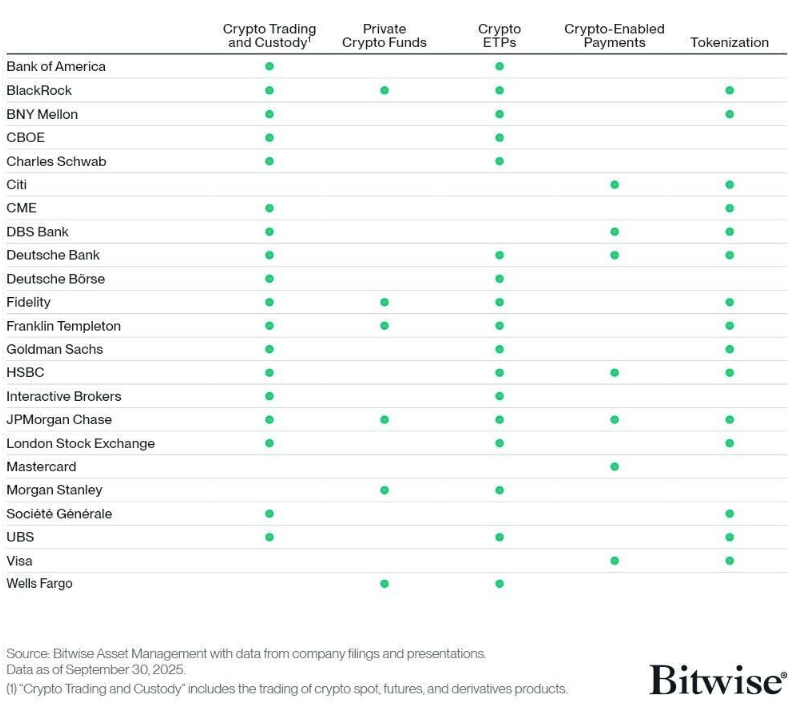
Institutionalization isn't about BTC ETFs or the price of a specific token based on an expanding buyer base; it’s about the migration of financial rails. The largest and most critical financial firms aren't just looking at the "crypto" sector; they are looking at how to move their own internal plumbing—settlement, custody, and issuance—onto a more efficient ledger. Just as the internet became the baseline for communication & commerce, blockchain is becoming the baseline for asset value creation, custody, and transfer. The below table is a telling representation of the movement of traditional financial firms towards a blockchain-based financial future.
Unlocking the "Quasi-Financial" Economy
In addition to blockchain offering enhanced productivity of existing financial assets, it is also serving to broaden the definition of what a financial asset truly is. Today, there are a number of assets that hold financial value, but because they are largely captive and either nontransferable or very difficult to transfer, their financial utility is heavily muted. Blockchain rails offer the potential to introduce a new breed of financial assets that could add significant financial flexibility to consumers, operators, and investors. These assets include: airline miles, reward points, gift cards, coupons, and even collectibles. The tokenization of these assets are in the earlier stages of transition, but they are already starting to establish a new potential for retail wealth creation and financial flexibility.
Looking further into the example of customer loyalty programs, these have always been "quasi-financial" in nature, holding real value but restricted by archaic, proprietary systems. By moving these onto blockchain rails, the assets can be transformed into productive financial instruments that serve to align the incentives of the consumer, the business, and even the passive investor. These assets would have the potential to evolve from “use it or lose it” to a potential dynamic of being instantly tradable, collateralizable, and interoperable.
The Bottom Line
For the sophisticated investor, the current "retail capitulation" in token prices appears to be merely short-term noise when compared to the long-term opportunity created by the "institutional acceleration" of the technology. We are moving away from the era of "investing in crypto" and toward an era where we invest in the companies and protocols that power, and expand, the world’s financial infrastructure.
In 1995, you didn't need to believe in every dotcom startup to realize the internet was going to change how the world worked. In 2026, you don't need to be a "crypto believer" to see that the world’s financial rails are being rebuilt in real-time.
Peter Hans, Partner @ Hack VC
Disclaimer
This newsletter (the “Newsletter”) is being furnished on a confidential basis to sophisticated investors (each a “Recipient”) for the purpose of providing certain information about Hack VC Management, LLC and its affiliates, including the funds it manages (collectively, “Hack VC”). This Newsletter is for informational and discussion purposes only and is not, shall not be construed as, and does not constitute an offer, invitation, or recommendation by Hack VC to sell or a solicitation to subscribe for or buy any interest in or assets from Hack VC, nor shall any securities in or assets of Hack VC or any other entity be offered, issued or sold to, any person in any jurisdiction in which such offer, solicitation, purchase, or sale would be unlawful under the securities or equivalent laws and regulations of such jurisdiction. Persons in possession of this Newsletter are required by Hack VC to inform themselves about any such restrictions and observe any such restrictions. Hack VC does not accept any liability to any person in relation to the distribution or possession of this Newsletter in or from any jurisdiction.
THIS NEWSLETTER IS FOR THE EXCLUSIVE USE OF THE PERSON TO WHOM IT IS ADDRESSED AND THEIR ADVISORS. IF THE RECIPIENT HAS NOT RECEIVED THIS NEWSLETTER FROM HACK VC, OR ANY ENTITY OR INDIVIDUAL AUTHORIZED BY HACK VC AS CONFIRMED BY HACK VC IN WRITING, OR YOU BELIEVE YOU RECEIVED THIS NEWSLETTER IN ERROR, PLEASE NOTIFY HACK VC IMMEDIATELY. THE UNINTENDED RECIPIENT MUST ALSO PERMANENTLY DELETE AND DESTROY ALL COPIES OF THIS NEWSLETTER FROM THEIR COMPUTER SYSTEM AND OTHER STORAGE DEVICES. UNINTENDED RECIPIENTS ARE HEREBY NOTIFIED THAT ANY DISSEMINATION, DISTRIBUTION, COPYING, OR US OF THIS NEWSLETTER AND THE INFORMATION CONTAINED HEREIN, IS STRICTLY PROHIBITED.
By accepting this Newsletter, the recipient agrees that it will, and will cause its representatives and advisors to, use the information only to inform itself about its investment in certain Hack VC funds or discuss its potential interest in Hack VC, as applicable, and for no other purpose and will not disclose any such information to any other person without the prior written consent of Hack VC. Any reproduction of this information in whole or in part is prohibited, and recipients agree to return this Newsletter to Hack VC upon request.
Past and targeted performance is not necessarily indicative of future results. There can be no assurance that Hack VC will achieve comparable results, that targeted returns, diversification or asset allocations will be met, or that Hack VC will be able to implement its investment strategy and investment approach or achieve its investment objectives for its investment vehicles. Statements contained in this Newsletter are based on current expectations, estimates, projections, opinions, and beliefs of Hack VC. Such statements involve known and unknown risks, uncertainties, and other factors, and undue reliance should not be placed thereon. Additionally, this Newsletter may contain “targets” or “forward‐looking statements”. Actual events or results or the actual performance of Hack VC may differ materially from those reflected or contemplated in such statements. As a result, investors should not rely on such forward‐looking statements, opinions, or beliefs in making investment decisions. No representation or warranty is made as to future performance or such forward-looking statements, options, or beliefs. Certain information contained herein (including forward‐looking statements, economic and market information, and portfolio company data) has been obtained from published sources and/or prepared by third parties (including portfolio companies) and, in certain cases, has not been updated through the date hereof. While such sources are believed to be reliable, neither Hack VC nor its respective affiliates or employees is making representations as to their accuracy or completeness, and they should not be relied on as such or be the basis for an investment decision. The information set forth herein does not purport to be complete and is subject to change, and Hack VC does not have any obligation to update such information or make any notification if such information becomes inaccurate.
Hack VC and its affiliates (including but not limited to its directors, officers, employees, and agents) do not accept any responsibility whatsoever or liability for any direct, indirect or consequential loss or damage suffered or incurred by any Recipient or any other person or entity however caused (including but not limited to negligence) in any way in connection with this Newsletter.
Hack VC is neither a law firm nor an accounting firm, and no portion of this document should be interpreted as legal, accounting, or tax advice. Hack VC is a registered investment adviser with the United States Securities and Exchange Commission (the “SEC”). Registration of an investment adviser with the SEC does not imply any level of skill or training.